Business reality
Small teams are big enough to have real complexity, but too small to carry specialist management infrastructure in every function.
Aument for stretched leadership teams
For a business under 85 seats, the leadership team is often the fallback operating layer: the small group of people who spot opportunities, check facts, judge priorities, approve sensitive actions, keep recurring work from breaking, and put out fires when they occur. Ideally, most of that time would be spent on opportunity spotting and high-value judgement, but in reality this is difficult to achieve; sometimes it ends up just putting one fire out after another. Aument changes this, giving the team the tools needed to get out from under day-to-day issues with confidence and simultaneously assists them with the highest value activities.
Seller pre-emption Pre-empt category confusion: open with the buyer's operating pain, not "AI". The seller should anchor on one workflow that keeps coming back to leadership.
Enabling Leadership
The business does not need another tool that creates more output to review. It needs a system that helps leaders decide what matters, move work safely, align the team, and learn from what happened.
Small teams are big enough to have real complexity, but too small to carry specialist management infrastructure in every function.
Leadership becomes the integration point for revenue, operations, risk, decisions, escalation, strategy, and memory.
Set up a governed work loop around one recurring workflow: connect the facts, rank the work, route authority, create receipts, and measure proof.
Returned leadership time can be used for strategy simulation, trials/experimentation, better strategy selection, stronger alignment, and cleaner delivery of strategic and recurring work.
Through-line: Aument gives the business operating leverage where leadership is currently the workaround, then compounds that capacity into better strategy and execution.
Seller pre-emption Pre-empt "another tool": say Aument starts with a controlled proof loop, not a new place to check. The buyer should hear relief and proof before platform.
Safe workspace access
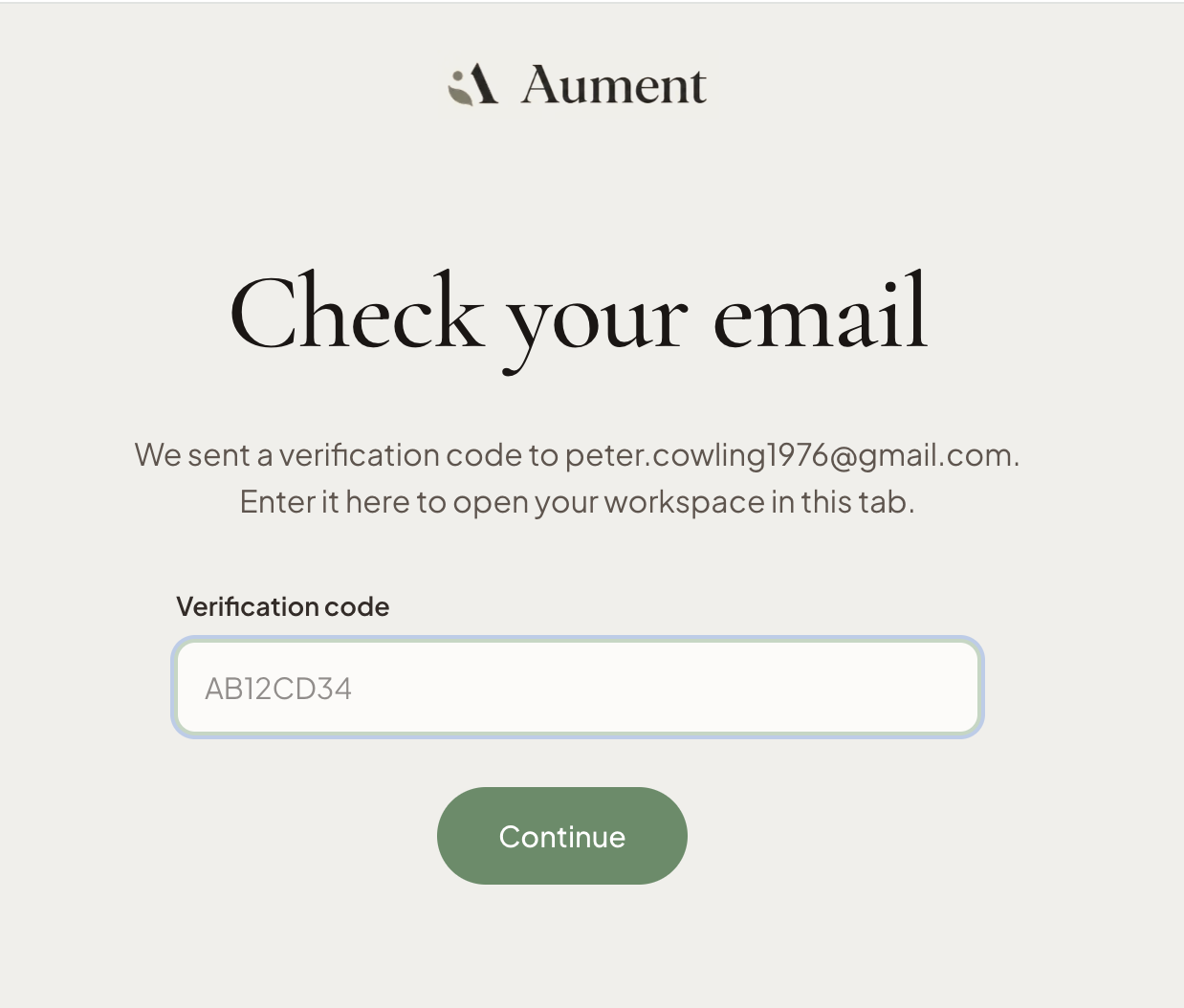
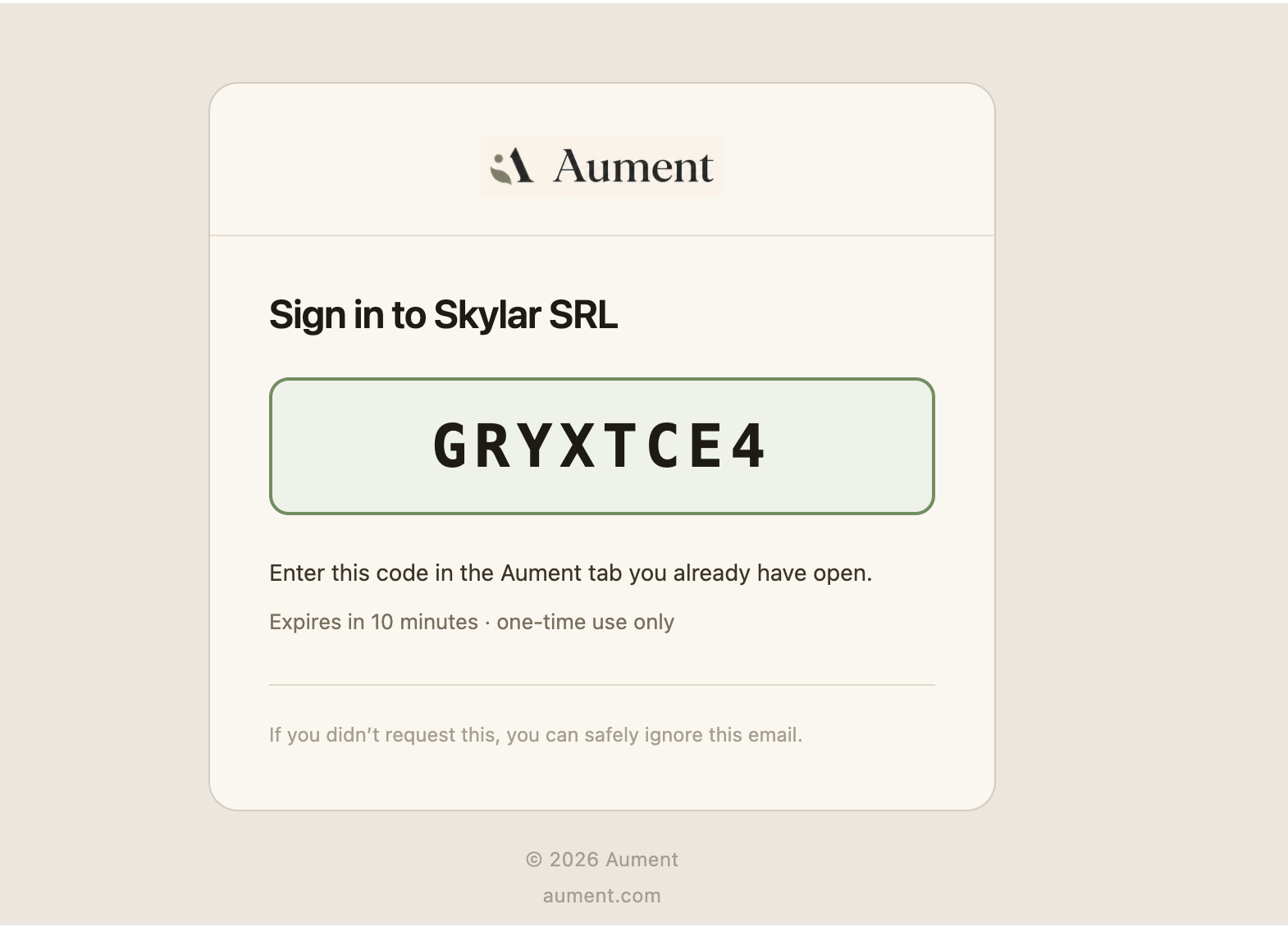
Before any workflow can be trusted, the buyer needs to see that Aument treats workspace access, tenant context, and verification as part of the operating system. The sign-in path is deliberately simple: enter the short-lived code, open the right workspace, and keep the business context bounded.
Seller lens
This deck is not just product positioning. It is a way for the seller to reduce the buyer's perceived risk: category risk, implementation risk, control risk, and value risk.
Say: one governed workflow loop. Do not make the buyer guess whether Aument is an agent, dashboard, consultant, or automation tool.
Say: agents produce outputs; Aument creates operating reliability: source facts, ranking, authority, action states, receipts, and proof.
Say: we are not asking for a transformation programme. We are testing one recurring workflow that already costs time, money, or risk.
Say: one accountable lead, one source set, one approval lane, one proof window. Narrow the scope before narrowing the price.
Say: recommend, draft, approve, act, block, and escalate are separate states. The buyer keeps control of sensitive decisions.
Say: the first loop must prove one thing - revenue motion, fewer leadership touches, faster resolution, risk control, or reusable operating cadence.
Part One
What can the business do once the leadership team no longer has to hold the process together personally?
Seller pre-emption Pre-empt "too broad": every part of the story must land on one recurring workflow, one authority lane, and one proof metric.
Leadership reality
These businesses are often not short of ambition, and certainly leadership/ownership recognize that the business being dependent on them - sometimes just to tick over - is not a good thing. What the business can be short of is: deep business development or other technical management skills, and focused, coordinated capacity. Conversely, the leadership team is trying to grow revenue, watch cash, handle exceptions, protect the business, support staff, keep customers happy, and still find time to think strategically.
Leads, quotes, bookings, renewals, upsells, reviews, abandoned carts, pricing ideas, and partner opportunities are visible but not consistently actioned.
Status checks, reports, reconciliations, customer replies, follow-ups, handoffs, troubleshooting, actively fixing issues, and exception routing quietly consume management attention.
Policies, claims, refunds, compliance steps, tax items, customer promises, and sensitive outputs depend on memory and informal approval.
When context, evidence, authority, and tradeoffs are not encoded, routine decisions come back to the same few people least able to absorb them. Senior leaders are also an expensive way to absorb this type of work - both in direct cost and opportunity cost.
Seller pre-emption Pre-empt "our business is unique": agree that the details are unique, then look for the repeated pattern - the weekly workflow where leadership still supplies context.
The hidden work
| Leadership job today | What it costs | What should happen instead |
|---|---|---|
|
Opportunity scout Leadership notices the commercial signal. |
Growth ideas depend on spare attention and rarely become a weekly operating cadence. | A ranked revenue plan is built from real sources and refreshed as part of the business rhythm. |
|
Operations router A senior person resolves the status, handoff, or exception. |
Low-value coordination steals the hours needed for growth, hiring, partnerships, and strategy. | Recurring work becomes a queue with accountability, source readiness, next actions, and receipts. |
|
Risk governor Leadership decides what can be promised, sent, refunded, claimed, or actioned. |
Delegation feels unsafe because no one can see support limits, approvals, or policy boundaries. | Sensitive actions are routed through evidence, authority, approval state, and support-limit checks. |
|
Strategy and context holder Leadership holds the strategy, customer nuance, exceptions, and tradeoffs. |
The business slows whenever the right leader is unavailable or mentally full. | Strategy, source facts, decisions, approvals, outcomes, and learning become maintained context. |
Seller pre-emption Pre-empt "I already know this": the value is not discovering that leadership is overloaded. The value is turning known pain into owned, governed, measurable cadence.
Why agents alone do not solve it
Drafting, search, analysis, and task automation are useful. But if leadership still has to check every fact, rank every option, approve every grey area, chase every handoff, and remember every result, the tool has moved work around rather than removed the bottleneck.
An agent can respond well to a simple request, but the business still needs to know which request matters most.
Outputs are weaker when the system cannot see source quality, stale facts, missing data, strategy, or constraints.
Automation becomes risky when it cannot distinguish advice, draft, approval, action, abstention, or blocked claims.
One impressive answer does not show whether the action was consumed, useful, safe, repeated, or worth expanding.
The sharper product story: it is not only what agents cannot do. It is what leadership teams cannot keep doing because they are forced to compensate for everything tools, teams, and processes do not coordinate.
Seller pre-emption Pre-empt "why not an agent?": do not argue that agents are weak. Say agents are useful, but Aument is the layer that decides what matters, what is safe, who approves, and whether it worked.
Aument definition
A workflow is a recurring part of the business where evidence, decisions, actions, and outcomes meet: revenue follow-up, stay readiness, commerce readiness, reporting, refunds, support triage, compliance checks, delivery handoffs, or any other repeatable area where leadership is still the fallback.
Connect sources, goals, constraints, roles, policies, current state, readiness gaps, and what the evidence does or does not support.
Rank candidate moves by value, evidence, confidence, urgency, risk, timing, capacity, and strategy fit.
Separate recommend, draft, approve, act, abstain, block, escalate, and roll back where supported.
Create receipts, proof metrics, outcomes, reasons work was not used, and learning for the next cycle.
Seller pre-emption Pre-empt "what exactly is it?": make the product concrete as sources -> ranked work -> approval state -> safe action -> receipt -> proof.
Ask Aument
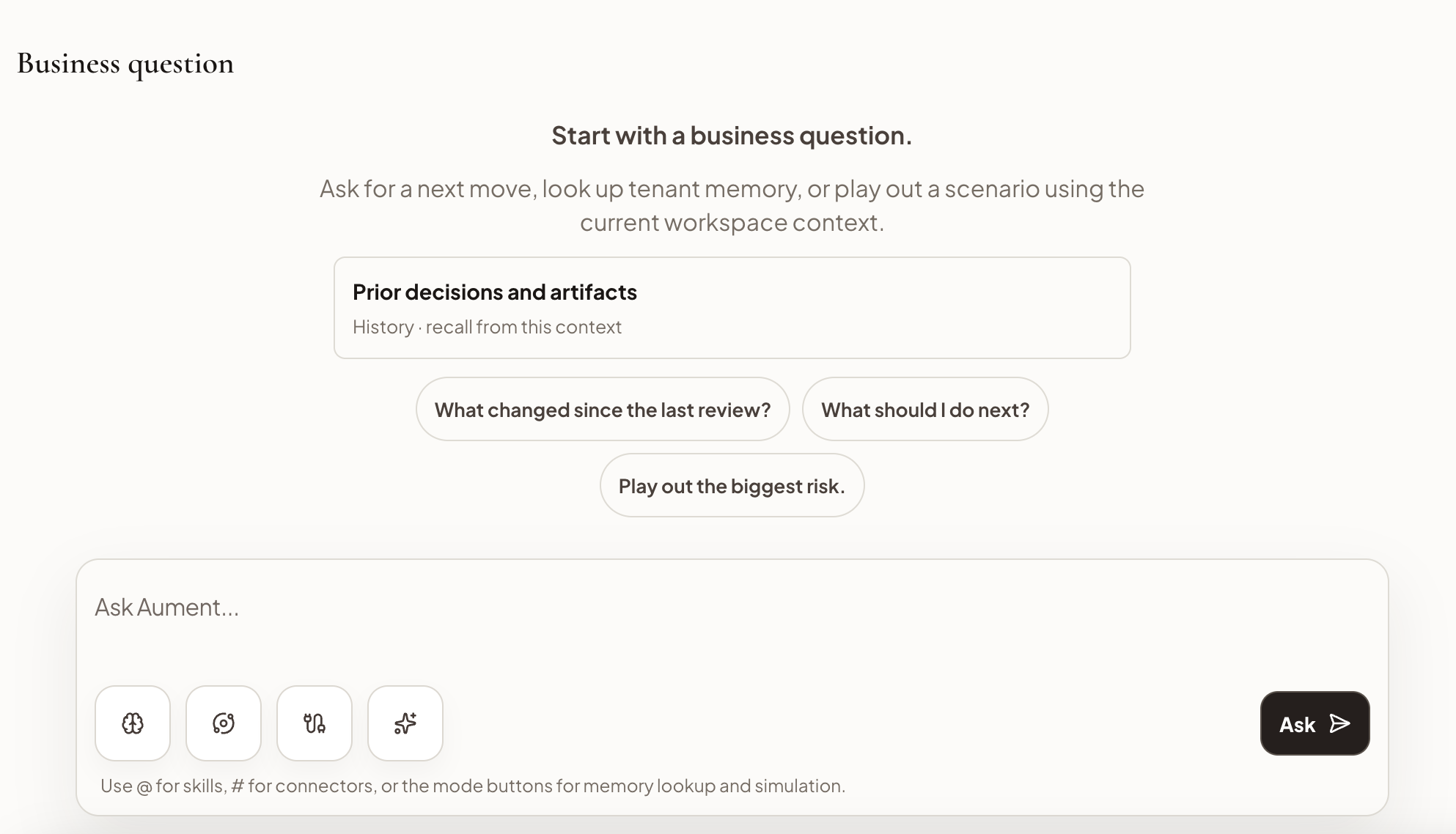
The question box is not positioned as generic chat. It is the entry point for memory lookup, source-backed reasoning, scenario testing, connector-assisted work, and governed recommendations inside the current workspace context.
Product surface
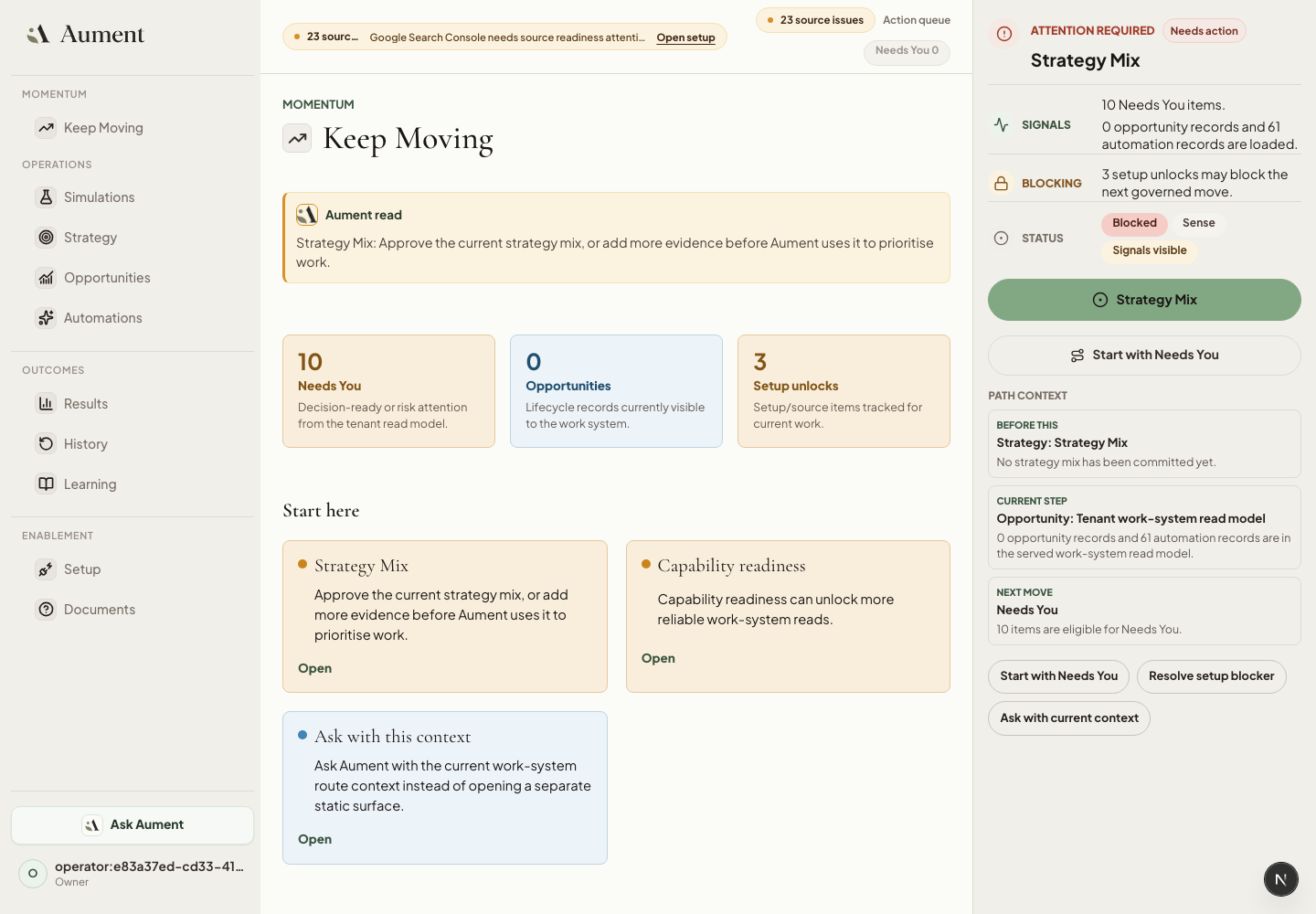
In the authenticated Skylar SRL workspace, the leadership view starts with what needs attention, why it matters, which setup or source issue is blocking progress, and which action lane is available next. This is the product shape behind the narrative: context, readiness, priority, and authority are visible in the same place.
How the system works
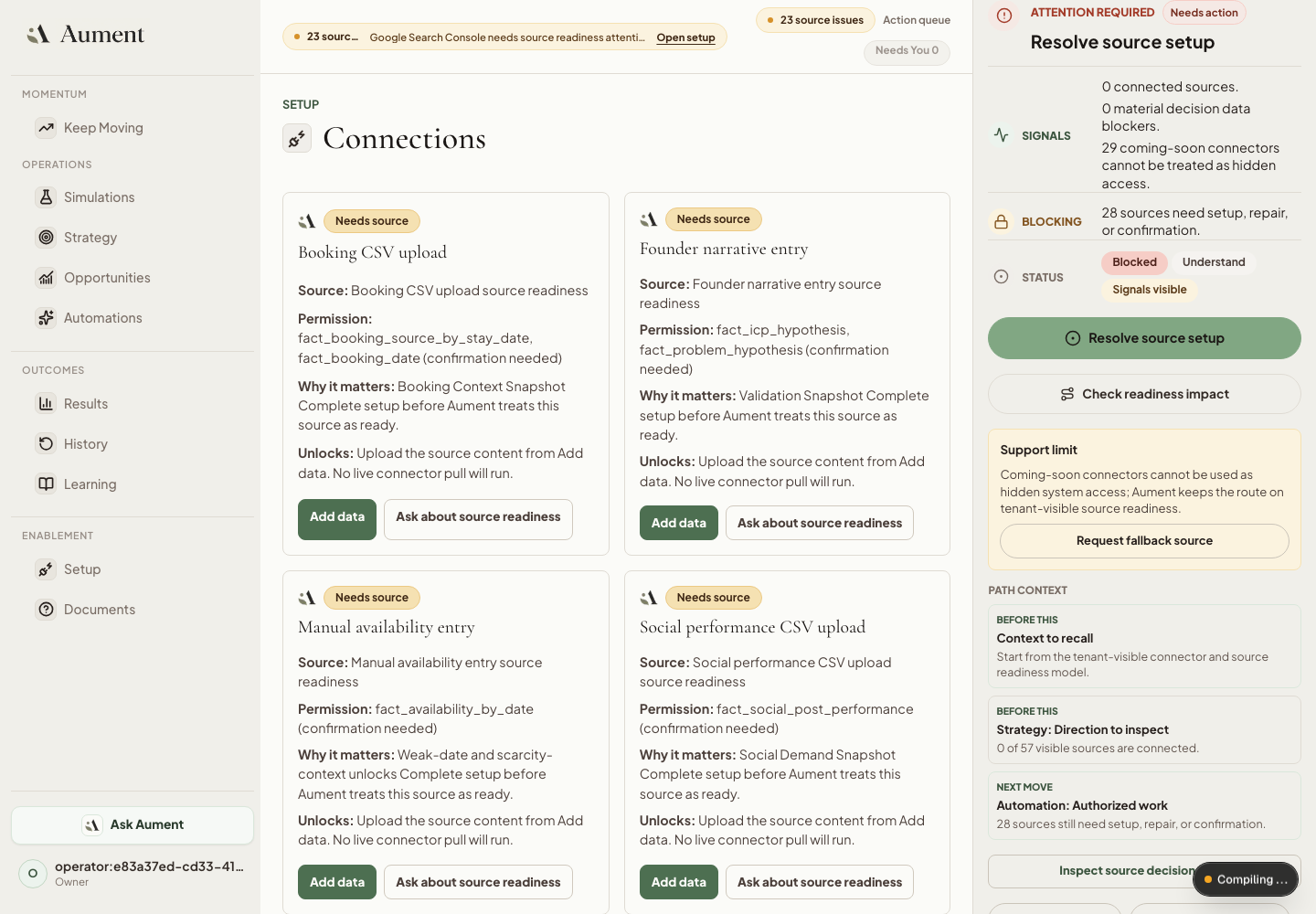
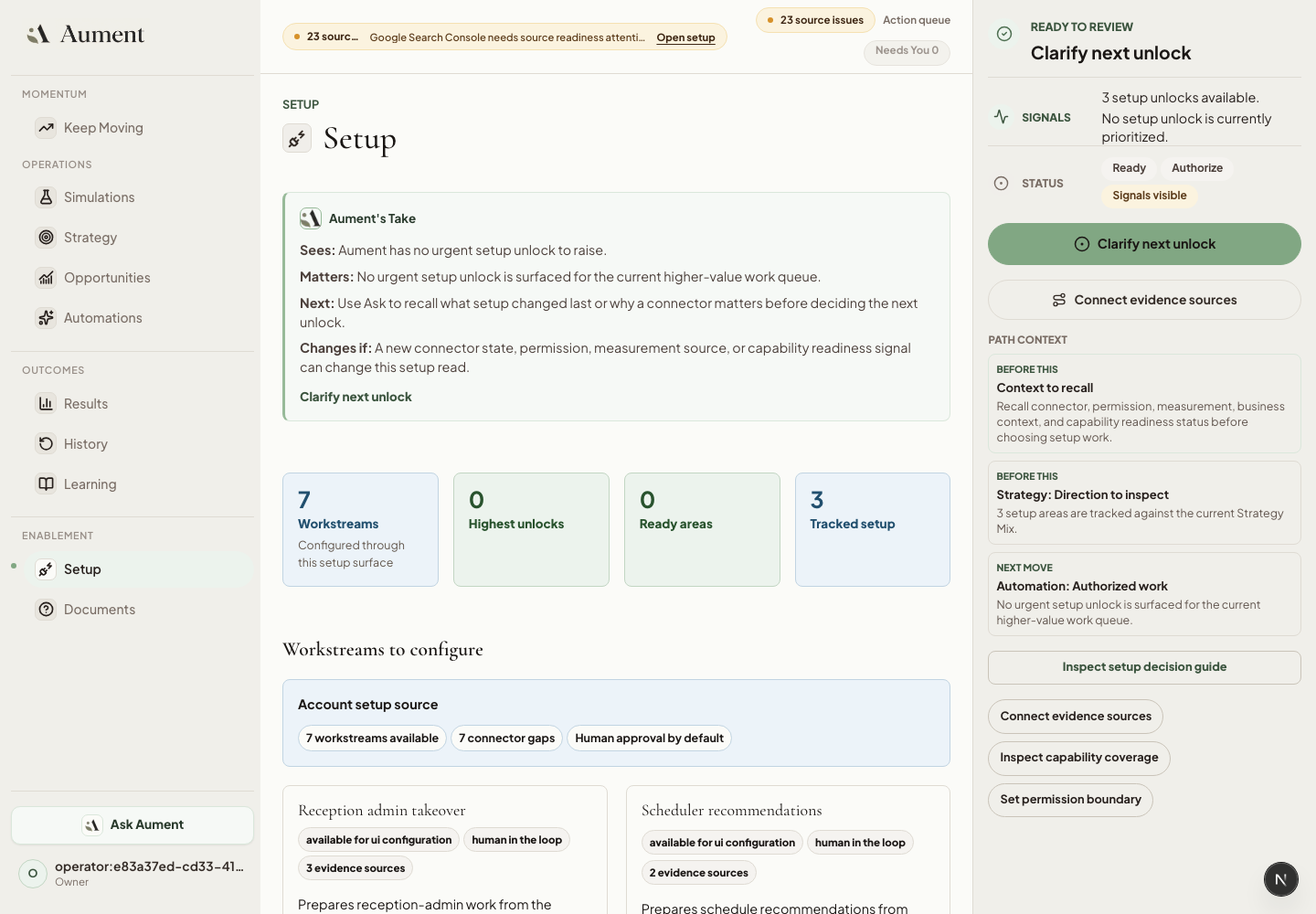
Source and setup readiness
The system does not treat every connector, file, or business fact as equally action-ready. It exposes source gaps, permission boundaries, setup unlocks, and support limits so the business can improve readiness before relying on recommendations or external actions.
What makes it unique
| Unique layer | Problem it solves | Leadership benefit |
|---|---|---|
| Source-backed | Business facts are scattered, stale, partial, private, or unsupported by the evidence available. | Leadership does not have to personally verify every fact before work can move. |
| Ranked | There are always too many possible actions and not enough capacity to pursue all of them. | The business gets a useful next plan, not a brainstorm or a longer backlog. |
| Governed | Delegation is unsafe when authority, approval, privacy, spend, and evidence limits are unclear. | Leadership can let work move without losing control of sensitive decisions. |
| Measurable | AI outputs are hard to value when no one knows whether they were used or changed anything. | The business can continue, stop, or expand a loop based on proof. |
| Strategically aligned | Urgent work can outrank important work when strategy is not part of day-to-day prioritisation. | The next work is selected against goals, constraints, risk appetite, timing, and capacity. |
| Repeatable | One-off analysis does not create operating leverage if the same work restarts every week. | Recurring work compounds instead of returning to leadership as a fresh problem. |
Seller pre-emption Pre-empt jargon: translate each differentiator into buyer language - "facts I can trust", "the next thing worth doing", "control over sensitive actions", and "proof it changed the business".
The business return
Find and rank the commercial moves the business has evidence for but does not consistently pursue.
Convert repetitive, boring, admin-heavy work into source-backed queues, drafts, checks, and governed routines.
Make customer claims, compliance steps, refunds, spend, approvals, and external outputs controlled and auditable.
Separate genuinely senior-only work from work that only returns to leadership because the business lacks context and rules.
The compounding effect: once leadership time comes back, the team can simulate strategy, choose strategy, align people, and deliver strategic and recurring work with less drift.
Seller pre-emption Pre-empt soft ROI: choose the first metric before the proposal. Do not sell all four returns at once; pick the one the buyer cares about most.
Revenue leverage
In stretched businesses, revenue growth is often hidden in plain sight. The issue is not a lack of ideas. It is that no one has the time, context, evidence, and cadence to turn those ideas into a governed weekly revenue plan.
A weekly commercial plan: not a brainstorm, not another dashboard, but a ranked set of revenue-seeking moves with evidence, next action, approval posture, and proof metrics.
Seller pre-emption Pre-empt "our CRM already does this": the CRM stores tasks. Aument is positioned around selecting the work that deserves attention and proving whether it was acted on.
Cost leverage
Boring operations are expensive because they repeat. The business pays once through staff time and again through management attention. Aument should be positioned as a way to remove the recurring synthesis, chasing, rewriting, routing, and checking that keeps a small team stretched.
| Operational drag | Aument response | Leadership benefit |
|---|---|---|
| Facts are checked manually across inboxes, spreadsheets, CRMs, booking tools, storefronts, support systems, and finance tools. | Source readiness checks and maintained context reduce repeated synthesis. | Less time gathering facts before every decision. |
| Recurring work is done differently depending on who remembers it. | Loops define accountable lead, cadence, readiness, approval posture, evidence limits, and receipts. | Work becomes delegable without becoming uncontrolled. |
| Exceptions sit in Slack, email, spreadsheets, or a senior person’s head. | Exceptions become queues with blockers, next actions, confidence states, and review requirements. | Leadership sees the few decisions that matter instead of every unresolved detail. |
| Managers rewrite the same messages, reports, and updates. | Aument drafts from approved sources and routes sensitive outputs through approval where required. | Less low-value writing, less rework, and fewer unsupported claims. |
Seller pre-emption Pre-empt adoption risk: this is not more data entry. It should reduce repeated synthesis, chasing, rewriting, and unclear ownership.
Risk leverage
For stretched businesses, compliance and risk show up in practical moments: customer promises, product claims, refund decisions, privacy questions, documentation gaps, payment blockers, tax items, health and safety steps, and external messages that staff are unsure how to handle.
Outputs can be tied to source evidence, stale facts, missing data, low-confidence states, and clear limits on what is supported.
Sensitive work can be advised, drafted, reviewed, approved, blocked, or escalated rather than guessed.
The business can see what was recommended, what was approved, what was actioned, and why.
Where supported, the system can carry reversibility, rollback, compensation, or demotion posture before execution.
Risk reduction is not a separate compliance story. It is part of leadership leverage: senior people can delegate more because the business can see what is supported, permitted, and controlled.
Seller pre-emption Pre-empt AI mistake anxiety: governance is the value. Aument should feel safer than ad hoc human memory or a confident unsupported AI answer.
Leadership leverage
This is the emotional centre of the story. Aument is compelling when it helps the founder and senior operators return to the work only they should be doing: growth, relationships, hiring, strategy, product, financing, and high-judgement exceptions.
| Senior-only today | Why it returns to leadership | What Aument creates |
|---|---|---|
| Customer escalations and exceptions. | No one can see the approved policy, source facts, or acceptable tradeoffs. | Review lanes, support limits, source-backed drafts, and escalation thresholds. |
| Commercial prioritisation. | The team has tasks, but not a ranked view of value, confidence, risk, and timing. | A ranked set of revenue or operating moves tied to evidence and capacity. |
| Reporting and operating reviews. | The facts are scattered and every update becomes a manual synthesis exercise. | Source-backed artifacts with support limits, outcomes, and customer-safe exports where appropriate. |
| Approval of routine grey areas. | Authority is not encoded, so staff ask leadership to make safe decisions safe. | Clear authority lanes for advise, draft, approve, act, abstain, or block. |
Seller pre-emption Pre-empt loss-of-control fear: Aument gives leaders fewer routine decisions to hold personally while making the remaining control points more explicit.
Strategic compounding
Aument does not only remove tasks. It changes what the leadership team can do with reclaimed attention: simulate strategic choices, select the right strategy, align the team around it, and deliver both strategic work and recurring work with less drift.
Test scenarios before changing spend, pricing, staffing, channels, service levels, customer experience, or operating cadence.
Compare options against evidence, upside, risk, constraints, capacity, timing, reversibility, and the goals the business has already chosen.
Turn strategy into ranked priorities, approval rules, source checks, operating cadence, and clear decision lanes.
Move strategic and recurring work through queues, drafts, approvals, receipts, outcome checks, and learning instead of relying on memory and urgency.
The compounding story: fewer recurring bottlenecks create more strategy time; better strategy creates clearer priorities; clearer priorities make routine work easier to delegate; measured outcomes improve the next decision.
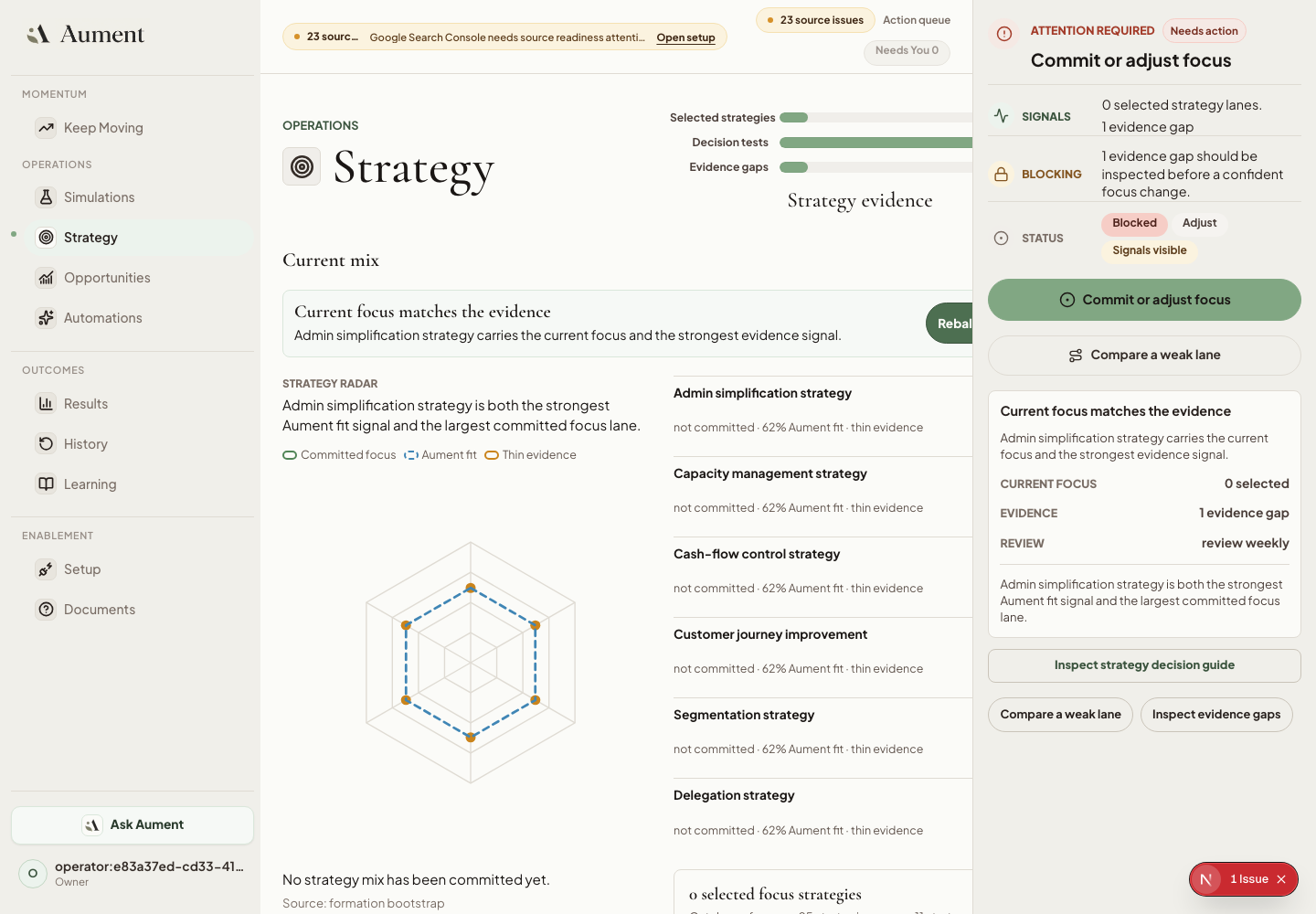
Strategy and simulation surfaces
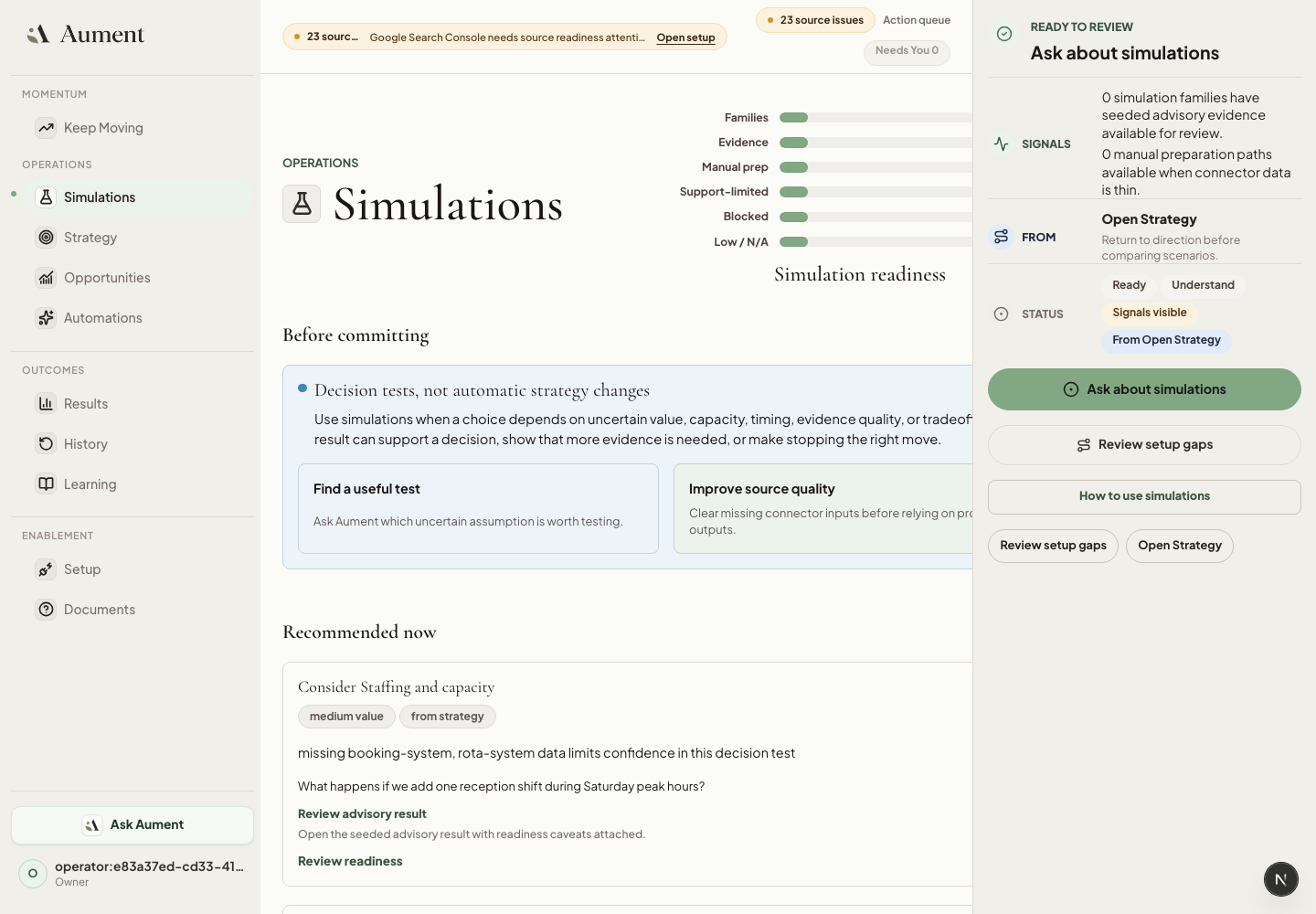
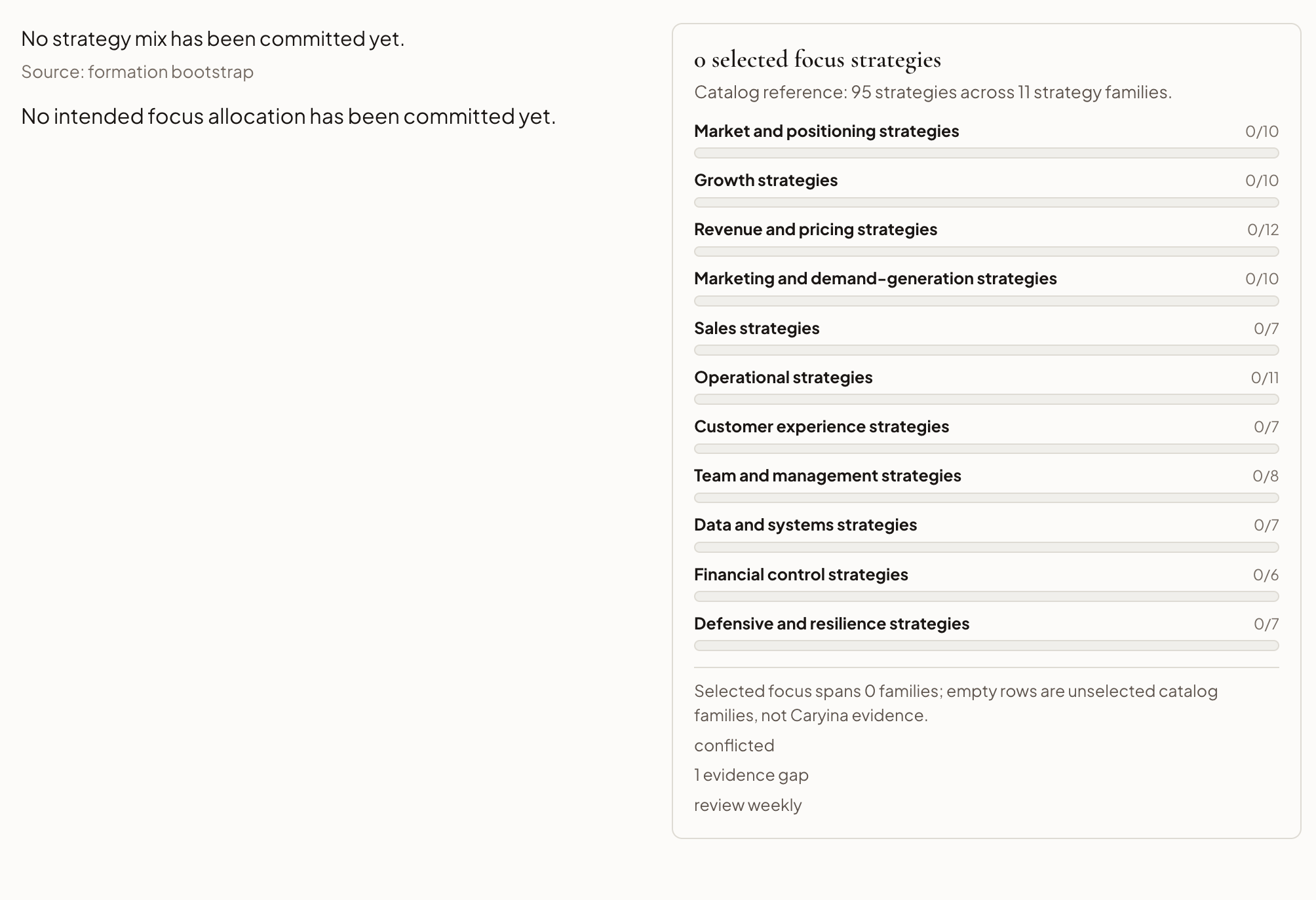
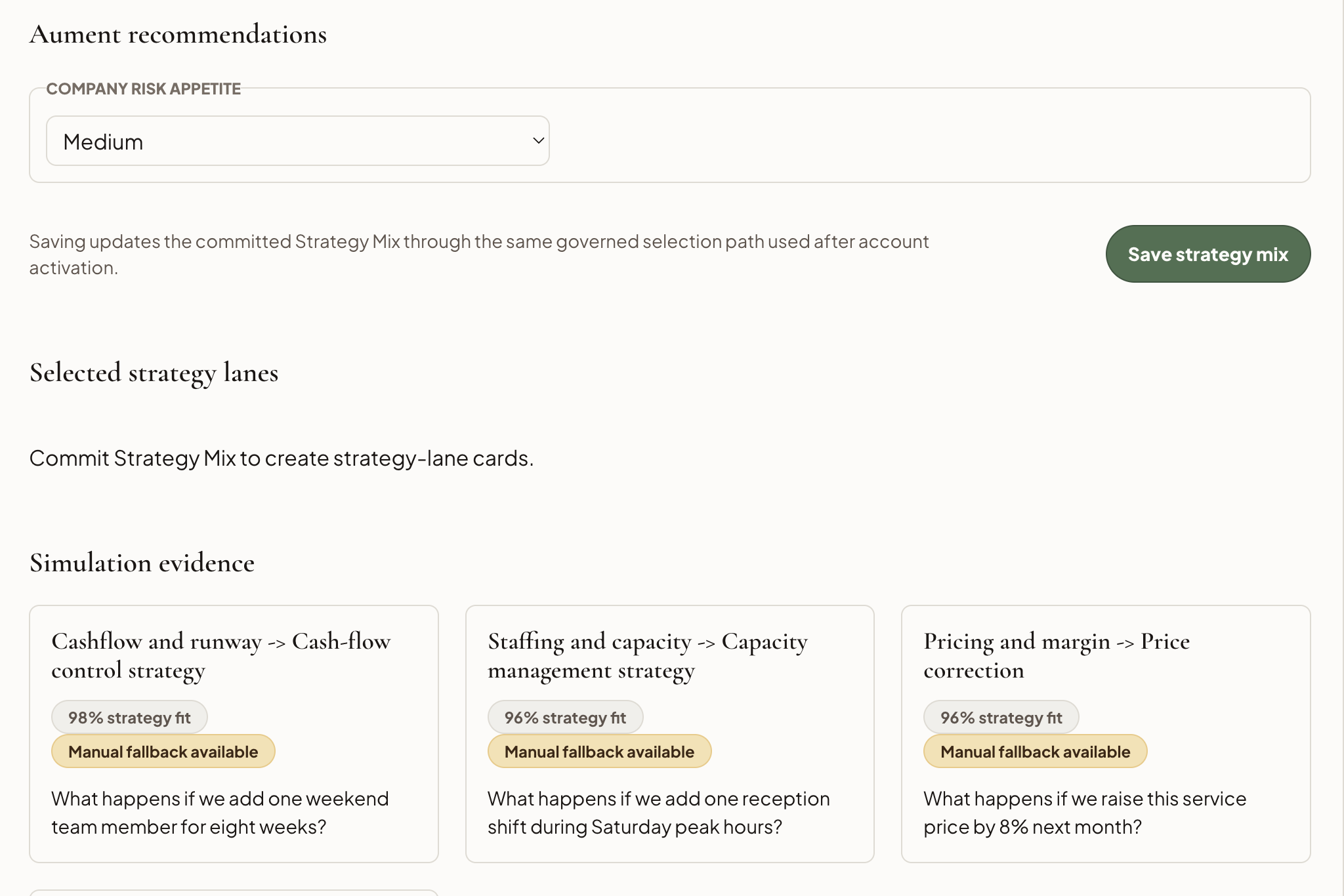
Strategy is not kept as a separate workshop artifact. Aument exposes the current strategy mix, evidence gaps, and decision prompts, then supports simulation where uncertainty, capacity, timing, or source quality should be tested before committing the business.
Strategy selection and recommendations
Strategy becomes operational when the system can show the available strategy families, the focus areas not yet selected, the simulation evidence available for each lane, and the governance path for saving a strategy mix.
Customer experience
Workflows, sources, readiness gaps, ranked work, exceptions, approval needs, proof metrics, and outcomes.
Which goal matters, which source is authoritative, who can approve, what is sensitive, and what would prove value.
Recommendations, drafts, queues, readiness projections, decision records, receipts, reports, and proof artifacts.
Prior decisions, outcomes, support limits, reasons work was not used, approval patterns, and scoped learning.
The leadership team should experience the system as: fewer avoidable questions, clearer next moves, safer delegation, stronger strategic alignment, and better visibility into whether work changed the business.
Seller pre-emption Pre-empt "show me the output": describe the Monday artifact - ranked queue, evidence, owner, approval state, next action, and proof signal.
Packaging
The whole operating system becomes credible after the first loop proves value. The opening offer should be narrow enough to inspect real sources, define authority, produce a useful output, and measure whether leadership gets capacity back.
Weekly opportunity plan from leads, quotes, bookings, orders, reviews, support, inbox, storefront, or CRM data.
Recurring process queue with source checks, blockers, drafts, exception routing, receipts, and fewer leadership touches.
Approval-sensitive claims, refunds, policies, documents, customer communications, or compliance steps with evidence limits.
Leadership decision queue mapped by source facts, authority, cadence, reversibility, and delegation lane.
Seller pre-emption Pre-empt implementation burden: keep repeating the first-loop constraint - one workflow, one accountable lead, one source set, one approval lane, one proof window.
Reference work areas
Hospitality, commerce, and other verticals should be described as proof candidates: recurring work areas where source evidence, approval boundaries, work receipts, and proof metrics can show whether Aument creates leadership leverage.
Aument can be framed around identifying stay-readiness blockers before they become front-desk exceptions: payments, city tax, documents, guest messages, allocation gaps, policy checks, and low-confidence requests requiring review.
Aument can be framed around checkout, storefront, orders, refunds, support, catalog, policies, measurement, readiness gaps, safe actions, review states, receipts, and proof metrics.
Professional services, logistics, construction, real estate, and manufacturing should be treated as research candidates until a specific recurring, source-backed, approval-sensitive loop is validated.
The safe posture is exploratory: use verticals to ask whether one governed proof loop is worth running, not to imply a complete production autopilot before readiness gates are satisfied.
Seller pre-emption Pre-empt vertical mismatch: the vertical is only a route into the conversation. The real qualification is whether a recurring, source-backed, approval-sensitive loop exists.
Product summary
Aument is not just a better agent. It is a governed operating system for the recurring work leadership teams are forced to coordinate manually. It makes a workflow clear, ranks the next useful work, routes sensitive actions through authority, produces proof, and learns from outcomes.
The product gives the business capacity back by making work source-backed, ranked, governed, measurable, repeatable, and strategically aligned.
Part Two
The sales motion should use the same story as the product narrative. Do not start with every capability. Start with the leadership constraint, identify which benefit matters most, and choose one governed proof loop that can show whether Aument creates leverage.
Seller pre-emption Pre-empt feature selling: the seller's job is to diagnose the leadership bottleneck and earn a proof loop, not to demo every capability.
Opening frame
“You probably have revenue opportunities the team cannot consistently work, admin that consumes management attention, risks that senior people personally hold, and decisions that keep coming back because the business lacks context. Aument is designed to pick one of those workflows and turn it into a governed work loop we can prove.”
“We have AI agents that can automate your business.”
“Where is your leadership team still acting as the operating system?”
“Which recurring process would give the team the most leverage if it stopped coming back every week?”
Seller pre-emption Pre-empt the AI-demo trap: if the buyer asks for "show me the agent", redirect to the workflow that would prove value in their business.
Ideal early customer
Seller pre-emption Pre-empt bad-fit deals: disqualify quickly when there is no recurring workflow, no authority, no source access, or no proof metric.
Qualification
| Question | Strong answer | Weak answer |
|---|---|---|
| Which workflow matters every week? | A named workflow with repeated decisions, handoffs, risk, or revenue impact. | A vague desire to “use AI” or “automate things.” |
| Who is accountable for the workflow? | A buyer or operator can sponsor access, approve outputs, and judge proof. | No accountable lead or authority to change the workflow. |
| Where do the facts live? | Source systems, files, inboxes, policies, or exports can be inspected. | Everything lives only in people’s heads or locked systems. |
| What is sensitive? | Claims, actions, customer contact, spend, refunds, or external outputs can be bounded. | No one knows what requires approval or what should be blocked. |
| What would prove value? | A 14–30 day signal such as more acted-on opportunities, fewer leadership touches, faster resolution, better risk control, better alignment, or reusable output. | No measurable output, no proof window, and no willingness to continue if the loop works. |
Seller pre-emption Pre-empt data messiness: messy sources are not an automatic no. The diagnostic tells the buyer what is good enough, missing, stale, sensitive, or unsafe to act on.
Conversation flow
Seller pre-emption Pre-empt loss of call control: do not jump from pain to product. Move in order: locate the bottleneck, name the benefit, inspect sources, bound authority, then prove one loop.
Discovery
Seller pre-emption Pre-empt vague pain: force specificity. Ask what the issue costs each week in missed revenue, duplicated work, delayed decisions, risk, or leadership touches.
First engagement model
Purpose: identify the highest-leverage workflow where leadership is filling the operating gap.
Output: bottleneck map, source readiness map, authority map, first readiness projection, ranked action, support limits, and proof metric.
Purpose: test whether the loop is refreshed, reused, acted on, and measurable.
Output: recommendations, approval states, receipts, reasons work was not used, proof metrics, and product gaps.
Purpose: run the loop as part of the operating cadence.
Gate: sources, approvals, support limits, learning boundaries, receipts, and launch gaps are ready or explicitly accepted within scope.
If price is challenged, narrow the scope rather than discount the value: one workflow, one accountable lead, one source set, one approval lane, one proof window.
Seller pre-emption Pre-empt paid-diagnostic resistance: the diagnostic must leave behind a useful artifact even if the buyer does not proceed - workflow map, source-readiness view, authority map, and proof plan.
Proof-loop menu
| Benefit | Proof loop | Possible success signal |
|---|---|---|
| Revenue seeking | Weekly revenue-opportunity plan from CRM, orders, bookings, storefront, analytics, support, reviews, or inbox data. | Recommendations are acted on; opportunities are revived; conversion, follow-up, retention, or margin work becomes visible and measured. |
| Cost reduction | Exception-heavy operations queue with source checks, drafts, blockers, receipts, and review states. | Fewer leadership touches, faster resolution, less duplicated admin, clearer accountability, and lower time spent preparing facts. |
| Risk reduction | Approval-sensitive claims, customer communications, refunds, policies, documents, or compliance steps routed through evidence and approval limits. | Unsupported outputs are blocked or reviewed; sensitive actions are approved; the business gets receipts and visible evidence limits. |
| Strategy and alignment | Strategy simulation and priority-setting loop that compares options, ranks the next work, and connects recurring work to the chosen direction. | Leadership can choose, explain, align, and deliver strategic work instead of only reacting to the week’s urgent tasks. |
| Leadership capacity | Leadership decision queue mapped by source facts, authority, reversibility, cadence, and delegation lane. | Leadership approves fewer routine items, sees only higher-value exceptions, and regains time for strategy, growth, and alignment. |
Seller pre-emption Pre-empt too many use cases: pick the proof loop by benefit, not by feature. The first loop should answer one commercial question.
Product-shaped proof
Workflow, source readiness state, source refs, evidence refs, support limits, missing inputs, and setup gaps.
Top ranked action, decision rationale, confidence, risk posture, authority lane, human-review state, and blocked reasons.
Draft, action decision, approval state, work receipt, command receipt where relevant, rollback or compensation posture where supported.
Proof metric, outcome ref, weekly reuse signal, reason work was not used, product gap, launch gap, and repeatability score.
Manual is acceptable. Ungoverned is not.
Manual
work should still follow source, readiness, authority, receipt, and
proof discipline.
Seller pre-emption Pre-empt "is this consulting?": manual support is acceptable only when it follows the product discipline - source, readiness, authority, receipt, and proof.
Proof surface
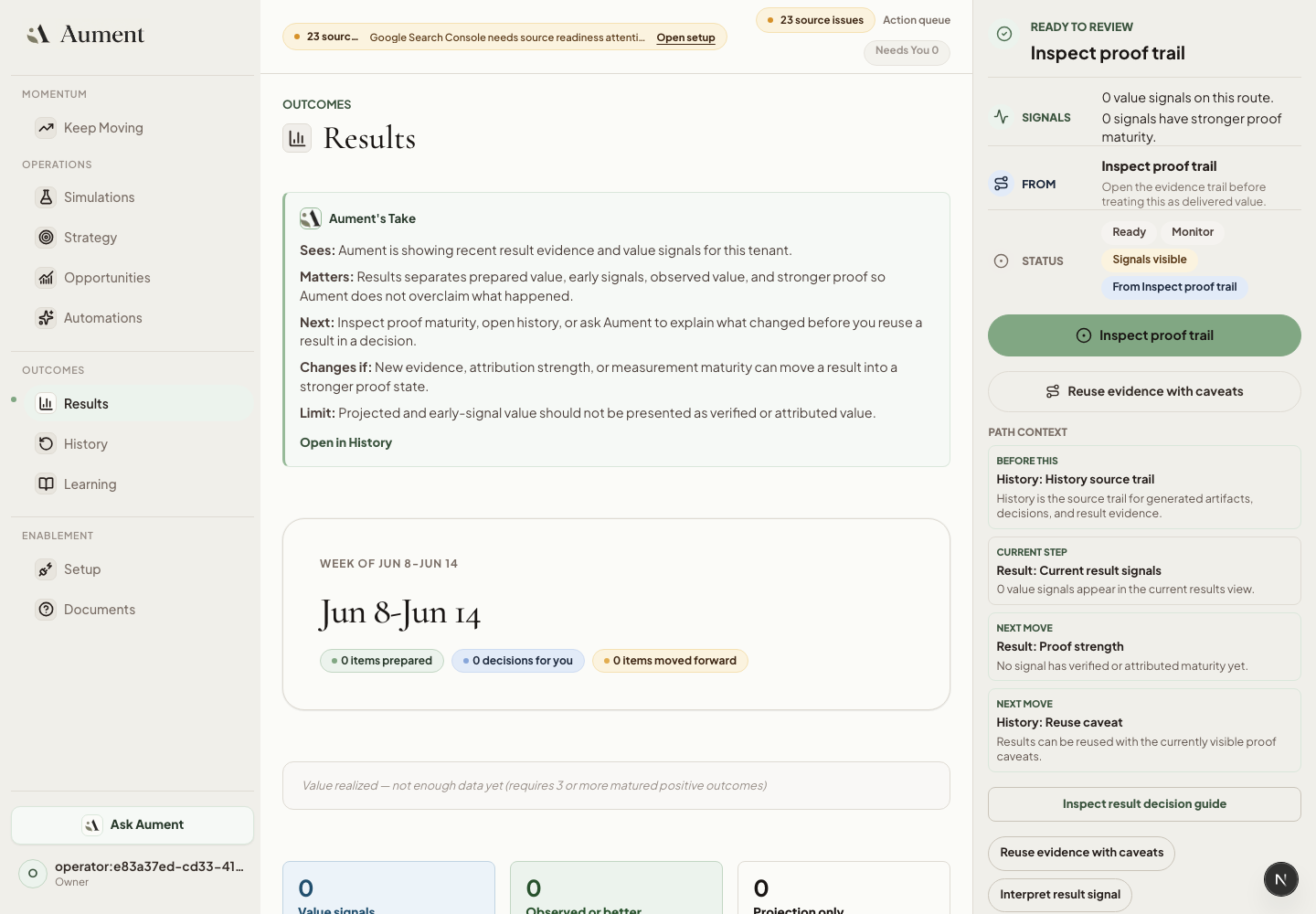
Aument separates prepared value, early signals, observed value, and stronger proof so the business does not overclaim what happened. That matters commercially: expansion should be based on evidence that a loop was useful, repeated, safe, and worth continuing.
Sales language
| Moment | Useful phrasing |
|---|---|
| Leadership leverage | “Aument helps identify where leadership is still the operating system and sets up a governed work loop around the first workflow worth fixing.” |
| Revenue | “The first loop can look for revenue opportunities your team already has evidence for but does not consistently work.” |
| Cost | “We are not trying to automate everything. We are trying to remove the recurring boring work that keeps stealing management attention.” |
| Strategy | “The real snowball is not only saved time. It is using that time to test strategy, choose the right work, align the team, and deliver the recurring work that supports the plan.” |
| Risk | “Aument can recommend, prepare, explain, route, and in approved lanes act — but only with source-backed evidence, support limits, approval state, and receipts.” |
| Leadership capacity | “The aim is to separate work that genuinely needs senior leadership from work that only comes back because the business lacks context and authority paths.” |
| Proof | “We should know inside the proof window whether this loop is being reused, whether recommendations are consumed, and whether leadership is getting capacity back.” |
Seller pre-emption Pre-empt inconsistent seller messaging: use the same simple contrast every time - not more AI output, but governed operating progress.
General closes
“Let’s pull up the systems that show leads, customers, orders, bookings, quotes, support signals, and outcomes. We can see whether Aument can produce a weekly opportunity plan worth acting on.”
“Let’s choose one repetitive process that steals leader or manager time. We can inspect the facts, define readiness states, route exceptions, and measure whether the loop reduces touches.”
“Let’s pick one sensitive workflow where unsupported claims or actions would be costly. We can map evidence, approval rules, evidence limits, and receipts before anything is shared or actioned.”
“Let’s choose one strategic decision or recurring workstream that keeps drifting. We can inspect the evidence, simulate options, choose the next work, and measure whether alignment improves.”
“Let’s list the decisions that still come back to you and choose the one where a governed loop would give you the most time and control back.”
Seller pre-emption Pre-empt soft closes: the close is not "shall we talk again?" It is "let us inspect the real workflow and see whether the facts can support a proof loop."
Vertical closes
“Pull up stays, arrivals, payments, guest messages, city-tax requirements, documents, and room allocation. We can see whether Aument can create a stay-readiness projection, identify blockers, and show which actions require review or approval.”
“Pull up checkout, storefront, orders, fulfillment, refunds, support, catalog, policies, and measurement sources. We can see whether Aument can identify readiness gaps, show which actions are safe, blocked, or require review, and produce a useful action record.”
“Let’s first define the recurring workflow, the source facts, the accountable lead, the approval lane, and the proof metric. If those exist, we can test whether an Aument-style loop is worth building.”
Keep the language exploratory where production readiness is not yet proven. The claim is a governed proof loop, not an unsupported autonomous autopilot.
Governance boundaries
Seller pre-emption Pre-empt overclaiming: this slide protects the seller. Use it when the buyer pushes for autonomous action, external sharing, or unsupported production promises.
Capture schema
vertical, workflow, leadership pain, buyer role; revenue opportunity, cost drag, risk exposure, strategic bottleneck; source systems, source refs, source readiness state; readiness projection, first blocker, top ranked action; approval state, human-review state, support-limit refs; work receipt, command receipt where relevant, proof metric, proof window.
manual work required; sensitive exports or actions; reason work was not used; weekly reuse signal; willingness to pay; repeatability score; product gap, launch gap, rollback or demotion posture, promotion candidate.
This is not sales administration. It is evidence about which leadership-leverage loops are valuable, repeatable, measurable, governed, and worth productizing.
Commercial close
One painful workflow where leadership is over-involved, sources are accessible, authority can be defined, and proof can be measured.
More workflows, richer source coverage, stronger approval lanes, recurring work, strategy simulation, better reports, and clearer outcome learning.
Aument becomes the operating layer for revenue opportunities, boring operations, risk control, strategic alignment, leadership leverage, proof, and learning.
Seller pre-emption Pre-empt premature expansion: the first sale is permission to prove one loop. Expansion is earned by receipts, reuse, outcomes, and fewer leadership touches.
Final framing
The best opportunity statement is simple: this workflow matters every week; the evidence is scattered; the next action is often unclear; some actions are sensitive; leadership is still the fallback; and Aument can test whether a governed work loop creates revenue, removes drag, reduces risk, or frees time for strategy and delivery.
Aument gives stretched businesses a way to grow without making leadership the only thing holding the business together.
Seller pre-emption Transition for the seller: a skeptical owner is not being negative. They are testing whether Aument will save time without taking control, creating risk, or becoming another failed tool.
Part Three
When a buyer says "why not use an agent?" or "technology has never helped us," the seller should not become defensive. Those objections are useful signals. They reveal what the buyer needs to trust before Aument can move forward.
Will this reduce work, or create another system to manage?
Will leaders stay in charge of sensitive decisions?
Will the proof loop show value quickly enough to justify expansion?
Will customers, staff, and external outputs be protected from unsupported action?
Objection map
| What they say | What they may mean | Seller response |
|---|---|---|
| "Why not just use an agent?" | They think the category is generic AI output. | Do not compete on cleverness. Reframe to operating reliability: sources, ranking, authority, receipts, and proof. |
| "Technology has never helped us." | They have bought tools that created admin, low adoption, or stale dashboards. | Validate the scar tissue. Aument starts as a contained proof loop around one painful workflow. |
| "This sounds like work." | They fear implementation burden before payoff. | Reduce the ask: one lead, one source set, one approval lane, one proof window. |
| "Our data is messy." | They worry the system will fail or expose internal disorder. | Source readiness is part of the value. The first step is to identify what is usable, missing, stale, or unsafe. |
| "Will my team use it?" | They have seen adoption fail when tools add steps. | Position Aument as removing ambiguity, chasing, rewriting, and repeated questions - not as another place to feed data. |
| "What if it makes a mistake?" | They fear liability, customer harm, or loss of control. | Show the action states: recommend, draft, approve, act, block, escalate. Sensitive moves require approval. |
| "What is the ROI?" | Leadership capacity feels soft unless tied to money, speed, risk, or time. | Pick one primary proof metric before the proposal and tie it to the chosen workflow. |
Agent objection
The wrong answer is "our AI is smarter." The right answer is "an agent is useful for tasks; Aument is for recurring work that must be safe, owned, measured, and repeated."
"You may absolutely use agents for individual tasks. Aument is for the repeated workflow where the business needs to know what matters, which facts are reliable, what can move without approval, what happened, and whether it was worth repeating."
Prior tech failure objection
"That is a fair concern. Many tools create dashboards and admin rather than removing work."
"We are not starting with a platform rollout. We are starting with one workflow that already costs you time."
"We define sources, authority, approval, and proof before anything becomes operational."
"If the loop does not show value, we do not expand it."
"The test is not whether the technology looks impressive. The test is whether one recurring workflow stops coming back to leadership in the same painful way."
Implementation objection
A buyer can believe the idea and still reject the project if the first step feels heavy. The seller should constantly reduce the first commitment to the minimum viable proof loop.
The recurring process that matters every week and keeps returning to leadership.
The person who can sponsor access, confirm the facts, and judge whether output is useful.
Exports or read-only access are enough to start where direct integrations would slow the deal.
Define what can be recommended, drafted, approved, actioned, blocked, or escalated.
Seller move: when scope grows, narrow it back. The first sale is not the entire operating system; it is one loop with a credible proof window.
Messy data and adoption
Risk, security, and control
| Buyer fear | What to show | Plain-language line |
|---|---|---|
| Wrong customer message | Draft/review/approval states and support limits. | "Sensitive outputs do not leave the business just because the system can draft them." |
| Unsupported claim | Evidence refs, stale facts, missing data, and blocked reasons. | "If the evidence does not support the claim, the loop flags or blocks it." |
| Loss of authority | Authority map and approval lane. | "Aument separates what can be suggested from what can be actioned." |
| Data exposure | Scoped source set, read-only/export start, sensitive data boundaries. | "We only need the sources required for the chosen workflow." |
| No audit trail | Receipts, outcome refs, approval state, and proof metric. | "The business can see what was recommended, approved, actioned, and why." |
ROI and diagnostic
"Leadership leverage" is emotionally strong, but it becomes commercially strong only when it is tied to a specific proof metric.
| Loop type | Primary proof metric | Diagnostic deliverable |
|---|---|---|
| Revenue | Opportunities found, acted on, revived, retained, converted, or reprioritised. | Opportunity-source map, ranked first action, approval posture, and weekly revenue-plan shape. |
| Operations | Fewer leadership touches, faster resolution, less duplicated admin, clearer ownership. | Workflow map, source-readiness state, blocker queue, and exception-routing plan. |
| Risk | Unsupported outputs blocked, sensitive actions reviewed, approval evidence captured. | Authority map, support-limit map, sensitive-action rules, and receipt structure. |
| Leadership capacity | Routine decisions removed from leadership, high-value exceptions isolated, cadence reused. | Decision queue, delegation lanes, proof metric, and expansion recommendation. |
Paid diagnostic line: "Even if we do not proceed, you keep a clear map of what is blocking delegation, automation, or safer operating cadence in this workflow."
The 60-second seller script
"You are right to be skeptical. Most tools add another place to check. We start differently: we choose one workflow that already costs you time, money, or risk every week. We inspect the real sources, define what the system can and cannot do, keep sensitive actions under approval, and measure whether the loop actually gets used. If it does not reduce leadership touches, reveal useful opportunities, or make the workflow safer and more repeatable, we do not expand."
"Which recurring workflow still comes back to you every week?"
"Where do the facts live, and which source would you trust first?"
"What would show in 14-30 days that this loop was worth continuing?"
Seller checklist
There is a named recurring workflow that matters every week and is painful enough to inspect.
Someone can approve access, define what is sensitive, and decide which actions require review.
The buyer agrees what success would look like and how quickly the first signal should appear.
Final seller framing
Skeptical owners do not need a bigger claim. They need a smaller, safer first step that makes the product real in their business.
Close on the workflow, bound the risk, prove the loop, then earn the expansion.